

How to Choose the Most Comfortable Running Shoe – Buyer Checklist
January 29, 2026Comfort is the single most important factor when choosing a running shoe. You can have the best-looking pair or the most expensive model on the shelf, but if your shoes cause discomfort, pain, or fatigue, your runs will suffer, and so will your motivation. The right running shoe should feel like a natural extension of your foot, supporting your stride rather than fighting it.
This guide breaks down exactly how to choose the most comfortable running shoe, step by step. Whether you’re a beginner, a daily jogger, or a long-distance runner, this buyer checklist will help you make a smart, injury-free decision.
Why Comfort Matters More Than Brand or Price
When selecting the best running shoes, prioritizing individual comfort over brand prestige or expensive price points is a science-backed strategy for success. Research suggests that a runner’s “comfort filter” is one of the most effective tools for injury prevention, as the body naturally gravitates toward footwear that complements its unique biomechanics. When a shoe causes even minor discomfort, it can alter your gait, leading to repetitive strain and common overuse injuries such as plantar fasciitis, shin splints, and chronic knee pain. By choosing a pair that feels natural from the first stride, you safeguard your joints and soft tissues, allowing for smoother recovery times and fewer days sidelined by inflammation or blisters.
Beyond physical health, the right fit significantly boosts running efficiency and metabolic economy. When you aren’t fighting a stiff sole or a cramped toe box, your muscles can focus entirely on forward propulsion rather than stabilizing an ill-fitting platform. This mechanical advantage directly impacts your long-term consistency; a comfortable runner is a motivated runner. While marketing trends may push “carbon-plated” speed or “maximalist” aesthetics, these features are only beneficial if they align with your foot’s specific needs. Investing in a shoe that provides the right balance of arch support, impact dampening, and flexibility ensures that your footwear remains a supportive partner in your fitness journey rather than a hurdle to your progress.
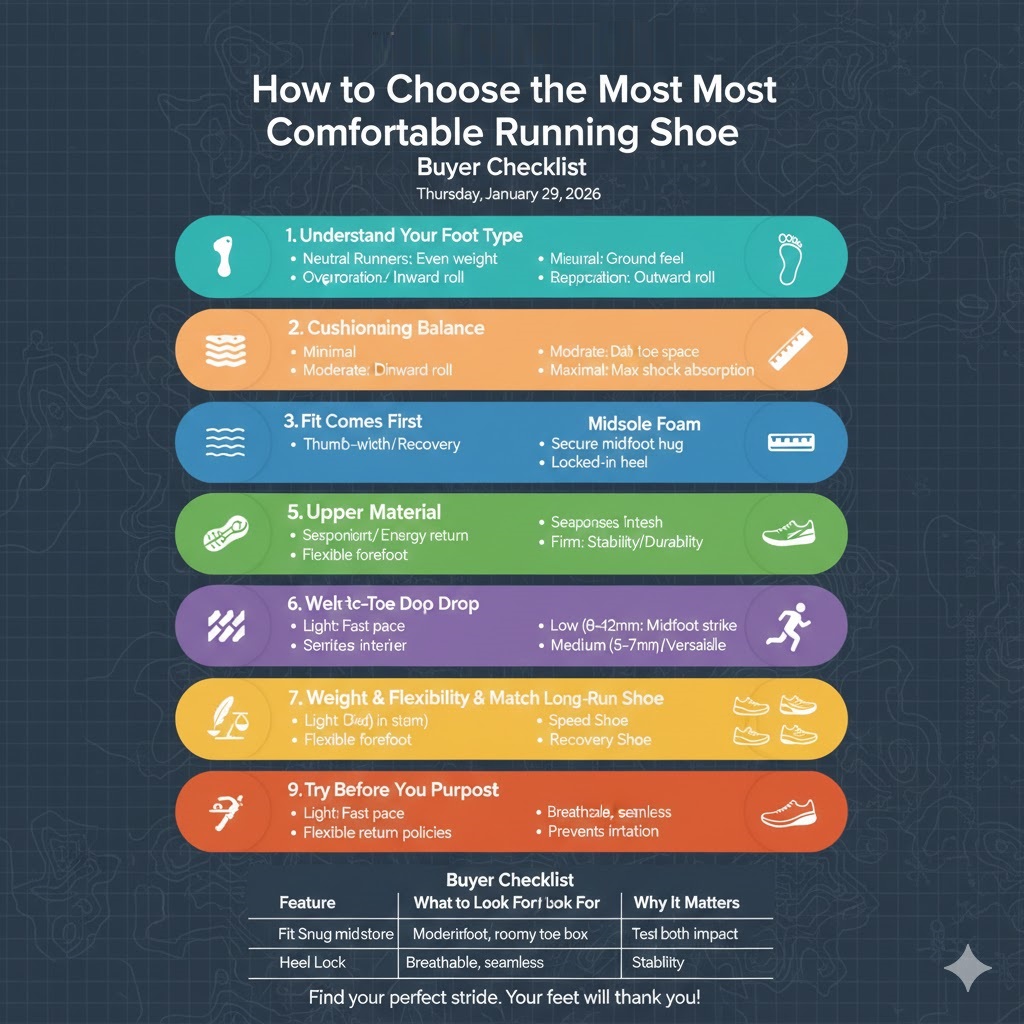
Step 1: Understand Your Foot Type (But Don’t Obsess Over It)
While traditional gait analysis once dictated rigid shoe categories, modern sports science has shifted toward a more holistic approach that prioritizes movement over static foot shapes. Understanding your foot type is still a valuable starting point for narrowing down the vast selection of athletic footwear, but it should serve as a guide rather than a rulebook. The three primary classifications, neutral, overpronation, and supination, describe how your foot absorbs impact during the gait cycle. A neutral foot typically displays an even distribution of weight, whereas overpronation involves an excessive inward roll that can strain the arches, and supination (or underpronation) describes an outward roll often associated with high, rigid arches.
Modern running shoe technology has evolved to a point where the lines between “stability” and “neutral” shoes are increasingly blurred. Most contemporary models are engineered with inherent stability features, such as wider platforms and flared midsoles, which provide a secure base for a variety of foot strikes. This means that unless you have a diagnosed orthopedic condition or a history of specific injuries, you shouldn’t feel restricted to a single category. Instead of focusing solely on whether you have a flat foot or a high arch, pay close attention to the dynamic comfort of the shoe. A shoe might feel supportive while you are standing still in a store, but the true test is how it manages the forces of impact during a run.
Ultimately, the best way to choose a shoe is to test it at your actual running pace. Your body is highly intuitive at sensing mechanical efficiency; if a shoe feels like it is “fighting” your natural stride, it likely isn’t the right fit, regardless of what a gait analysis might suggest. Look for a pair that provides a smooth transition from heel to toe-off and offers enough lateral stability to keep you feeling centered. By blending a basic understanding of your foot type with a heavy emphasis on how the shoe performs under load, you can find a pair that minimizes fatigue and maximizes your enjoyment on the road or trail.
Step 2: Cushioning – Find the Right Balance
Selecting the ideal level of midsole cushioning is one of the most critical steps in tailoring your running experience to your specific environment and goals. While it may be tempting to equate “plushness” with quality, the relationship between comfort and foam density is highly individual. Minimal cushioning is designed for runners who prioritize “ground feel” and a lightweight profile, though it provides significantly less shock absorption, which can increase the load on the lower legs. On the other end of the spectrum, maximal cushioning uses high-stack heights of advanced foams like EVA or Pebax to provide a plush, cloud-like ride. This is often the preferred choice for high-mileage athletes or those seeking recovery day shoes, as it effectively dampens the repetitive impact of hard surfaces.
For the majority of joggers and athletes, moderate cushioning offers a balanced “Goldilocks” zone, providing enough impact protection for daily training while maintaining a responsive, energetic feel. The choice of cushioning should also be heavily influenced by your primary running terrain. If your miles are logged on unforgiving asphalt, concrete, or treadmills, a higher level of shock absorption is generally more comfortable and can help prevent fatigue. Conversely, trail runners often benefit from slightly firmer midsoles; a shoe that is too “mushy” on uneven dirt or rocky paths can lead to instability and increase the risk of an ankle sprain.
The ultimate goal when testing a shoe’s cushioning is to find a platform that absorbs the vertical force of your stride without compromising lateral stability. You want to feel a sense of energy return rather than a “sinking” sensation that makes your legs work harder to push off. A high-quality running shoe should feel consistent from the first mile to the last, providing a stable base that protects your joints without feeling cumbersome. By matching your cushioning level to your body weight, running surface, and personal preference, you ensure a smoother ride that minimizes the risk of overuse injuries.
Step 3: Fit Comes First (This Is Non-Negotiable)
Achieving a precision fit is the most critical technical requirement for any running shoe, as even the most advanced foam technology cannot compensate for a poor anatomical match. To ensure maximum comfort and prevent common foot ailments, you must adhere to several key fitment rules. First and foremost is the thumb-width rule: there should be approximately a half-inch of space between your longest toe and the front of the shoe. This clearance is vital because your feet naturally slide forward and expand during the gait cycle. Without this buffer, you risk developing “runner’s toe” (bruised toenails) or painful blisters. Furthermore, the toe box must be wide enough to allow for natural toe splay, which provides the necessary stability and leverage during the “toe-off” phase of your stride.
The midfoot and heel sections of the shoe require a different kind of security. A high-quality fit should feel like a “secure hug” around the midfoot—snug enough to prevent the foot from sliding laterally, but without creating pressure points on the instep that could restrict circulation. Similarly, the heel counter must lock the rearfoot firmly in place. If you experience any heel slipping or vertical movement while walking or jogging, the friction will almost certainly lead to skin irritation or Achilles tendon issues. Ensuring a locked-in heel fit is non-negotiable for maintaining control over your mechanics, especially when navigating turns or uneven terrain.
Timing your shoe fitting is just as important as the measurements themselves. Because of the physiological effects of gravity and blood flow, your feet will swell and expand throughout the day and during physical exertion. For the most accurate assessment, it is highly recommended to try on new running shoes in the late afternoon or evening, or immediately following a light workout. This ensures you are sizing for your “largest” foot volume, preventing you from purchasing a shoe that feels great in the store but becomes painfully tight five miles into a long run. By prioritizing these structural fitment standards, you create a foundation for a pain-free running experience and better overall foot health.
Step 4: Pay Attention to the Midsole Foam
The midsole architecture is the structural heart of a running shoe, serving as the primary engine for both impact protection and energy return. When runners describe the “feel” of a shoe, they are largely reacting to the specific chemical composition of the midsole foam. For those who prioritize pure comfort and joint protection, soft foam technologies, often made from advanced Ethyl Vinyl Acetate (EVA) or Supercritical foams, provide a forgiving, pillowy sensation that is ideal for recovery days and low-intensity miles. These materials excel at dampening the vibrations of hard pavement, making your stride feel significantly more effortless. However, it is essential to ensure that the foam is “protective” rather than just soft, as a midsole that is too mushy can lead to premature muscle fatigue over longer distances.
Athletes looking for a more dynamic experience often gravitate toward responsive foams, such as Pebax or TPU-based compounds. These materials are engineered to provide a noticeable “bounce” or “pop” by storing energy upon impact and releasing it during the toe-off phase. This energy return makes these shoes feel fast and efficient, which many runners equate with a high level of performance-based comfort. On the other end of the spectrum is firm foam, which offers a more traditional, stable ride. While firm midsoles may lack the initial “step-in comfort” of plush models, they provide a highly predictable platform and superior long-term durability, making them a favorite for runners who require extra support or those who frequently tackle technical terrain where a stable base is paramount.
Ultimately, the “comfort magic” of a midsole is found in the balance between flexibility and protection. A shoe that is overly stiff may hinder your foot’s natural range of motion, while one that is too flexible might not provide the necessary structure for your arch. For the best experience, look for a midsole transition that feels smooth from heel-strike to forefoot-release. If you find a foam that absorbs the shock of the road without feeling like it is “sinking” or “fighting” your foot, you have likely found the perfect density for your body weight and running style. Prioritizing this underfoot feel ensures that your shoes remain comfortable through every stage of your training cycle.
Step 5: Upper Material Can Make or Break Comfort
The shoe upper acts as the crucial interface between your foot and the environment, serving as the primary source of security, temperature regulation, and structural support. A high-quality running shoe should feature a breathable engineered mesh or knit construction that promotes maximum airflow. This ventilation is not just a luxury; it is a functional necessity to prevent moisture buildup, which can lead to skin maceration and painful blisters during high-intensity training. When evaluating a shoe, pay close attention to the inner lining and tongue construction. The interior should feel seamless and plush; any rough seams or “hot spots” felt in the store will likely escalate into significant irritations after just a few miles on the road.
Support within the upper should be strategically zoned to provide a balance of lockdown and freedom. You want a structured midfoot often reinforced by internal overlays or specialized lacing systems, to prevent your foot from sliding off the midsole during turns. Conversely, the forefoot should remain flexible to accommodate the natural flexion of your toes and metatarsals. If an upper feels overly rigid or constricts the top of your foot (the instep), it can lead to extensor tendonitis or circulation issues. A comfortable upper should move with you, providing a “second-skin” feel that supports your anatomy without imposing a restrictive, plastic-like cage around your foot.
A common misconception in the running community is that shoes require a “break-in period.” In reality, modern performance running footwear should feel comfortable and functional the moment you lace them up. While the midsole may soften slightly over time, the upper is unlikely to stretch or change its shape significantly. If a shoe feels tight, scratchy, or uncomfortably stiff right out of the box, it is a clear indicator that the last (the mold the shoe was built on) does not match your foot shape. Prioritizing a pliant, seamless upper ensures that your focus remains on your pace and breathing, rather than on irritating friction or overheating.
Step 6: Heel-to-Toe Drop and Natural Stride
The heel-to-toe drop of a shoe is a critical, yet often overlooked, geometric measurement that dictates how your lower body manages impact forces. Measured in millimeters, the “drop” represents the difference in height between the cushioning at the heel and the cushioning at the forefoot. A high-drop shoe (8–12 mm) is the industry standard for traditional trainers; it shifts much of the mechanical load away from the Achilles tendon and calves and onto the knees and hips, making it an exceptionally comfortable choice for heel strikers. For runners who naturally land on the back of their foot, this extra elevation provides a smoother transition and reduces the strain on the lower leg during long-distance efforts.
Conversely, low-drop or zero-drop shoes (0–4 mm) are designed to mimic a more “natural” or barefoot-style gait by keeping the heel and forefoot on a level plane. While these shoes encourage a midfoot or forefoot strike, they require a significant adaptation period, as they place substantially more demand on the calf muscles and the plantar fascia. A medium-drop shoe (5–7 mm) offers a balanced middle ground, providing a versatile platform that accommodates various running styles without being overly aggressive in either direction. Choosing a drop that aligns with your current biomechanics is essential for injury prevention, as forcing your body into a new gait pattern too quickly can lead to strain and discomfort.
Ultimately, the most comfortable heel drop is the one that allows your body to move through its natural range of motion without restriction. If you are currently running pain-free, it is usually best to stick with a drop similar to what you are already wearing. Modern gait analysis suggests that your body is the best judge of efficiency; if a shoe feels “clunky” or causes you to trip, the drop may be too high, whereas if you feel immediate tightness in your calves, the drop may be too low. By matching the shoe’s geometry to your natural stride, you ensure that your footwear supports your movement rather than fighting against it.
Step 7: Weight and Flexibility Matter
While the absolute weight of a shoe is rarely the sole cause of discomfort, the power-to-weight ratio of your footwear plays a significant role in managing muscle fatigue during extended runs. A shoe that feels light on your foot reduces the metabolic cost of every stride, allowing you to maintain your form even as the miles add up. However, “lightweight” shouldn’t come at the expense of necessary structural integrity. A truly comfortable running shoe is defined by its ability to flex naturally at the forefoot, mimicking the biological hinge of your toes. If a shoe is too stiff or heavy, it can feel “clunky” or restrictive, forcing your lower leg muscles to work harder just to turn the shoe over, which often leads to premature exhaustion or “heavy legs” late in a session.
The ideal weight of your footwear should ultimately align with your running pace and specific training goals. Daily trainers are often engineered with a bit more heft because they prioritize long-term durability and maximum impact protection, making them the most comfortable choice for easy mileage and base building. In contrast, speed-work or tempo shoes utilize ultra-lightweight foams and stripped-back uppers to provide a “snappier” and more responsive feel. These shoes are designed to help you feel agile and quick on your feet during intervals or races. If a daily trainer feels like an anchor, or a speed shoe feels too flimsy to support your frame, then the weight distribution is likely mismatched for your needs.
When testing a new pair, pay attention to how the shoe moves through the “swing phase” of your gait. You want a platform that feels balanced—neither heel-heavy nor tip-heavy—and one that disappears underfoot once you reach your cruising speed. By selecting a shoe that offers the right amount of cushioning-to-weight efficiency, you ensure that your gear supports your endurance rather than becoming a physical burden. Whether you are a heavy-hitter looking for maximum stability or a featherweight runner seeking a minimalist feel, the most comfortable shoe is one that matches the rhythm of your stride without adding unnecessary bulk.
Step 8: Match the Shoe to Your Running Purpose
To maximize both performance and foot health, it is essential to align your footwear with the specific intent of your workout. Daily trainers are the versatile workhorses of the running world, engineered to provide a reliable balance of all-around comfort and long-term durability. These shoes are built to withstand the repetitive stress of everyday miles, making them the most practical choice for runners who want a consistent, supportive feel across various terrains. However, relying on a single pair for every type of training can lead to compromises; for instance, a heavy trainer might feel cumbersome during a sprint, while a thin racing shoe may lack the protection needed for a high-mileage week.
For specialized sessions, category-specific shoes can significantly enhance your comfort levels. Long-run shoes are typically designed with extra high-stack cushioning and added structural protection to safeguard your joints as fatigue sets in over several hours. Conversely, speed shoes prioritize a lightweight, responsive profile, often incorporating stiff plates or high-energy foams to help you maintain a fast turnover during tempo runs or intervals. On days when your body is sore, a recovery shoe provides maximum softness and a plush, forgiving platform that minimizes impact forces, allowing your muscles to recover while you still get your movement in.
| Shoe Category | Key Benefit | Best For |
| Daily Trainer | Versatility & Durability | Everyday base miles |
| Long-Run Shoe | Maximum Protection | Half-marathon/Marathon training |
| Speed Shoe | Energy Return | Intervals, tempo runs, and races |
| Recovery Shoe | Plush Impact Relief | Easy walks or light jogs after a race |
Ultimately, the most comfortable approach for a dedicated runner is to build a shoe rotation. By switching between different models based on the day’s objective, you not only extend the lifespan of each pair but also provide your feet and joints with varying stimuli, which is a proven method for injury prevention. When you match the shoe’s technical design to the demands of your run, you eliminate the mechanical friction that causes discomfort, ensuring that every mile feels purposeful and pain-free.
Buyer Checklist: Most Comfortable Running Shoe
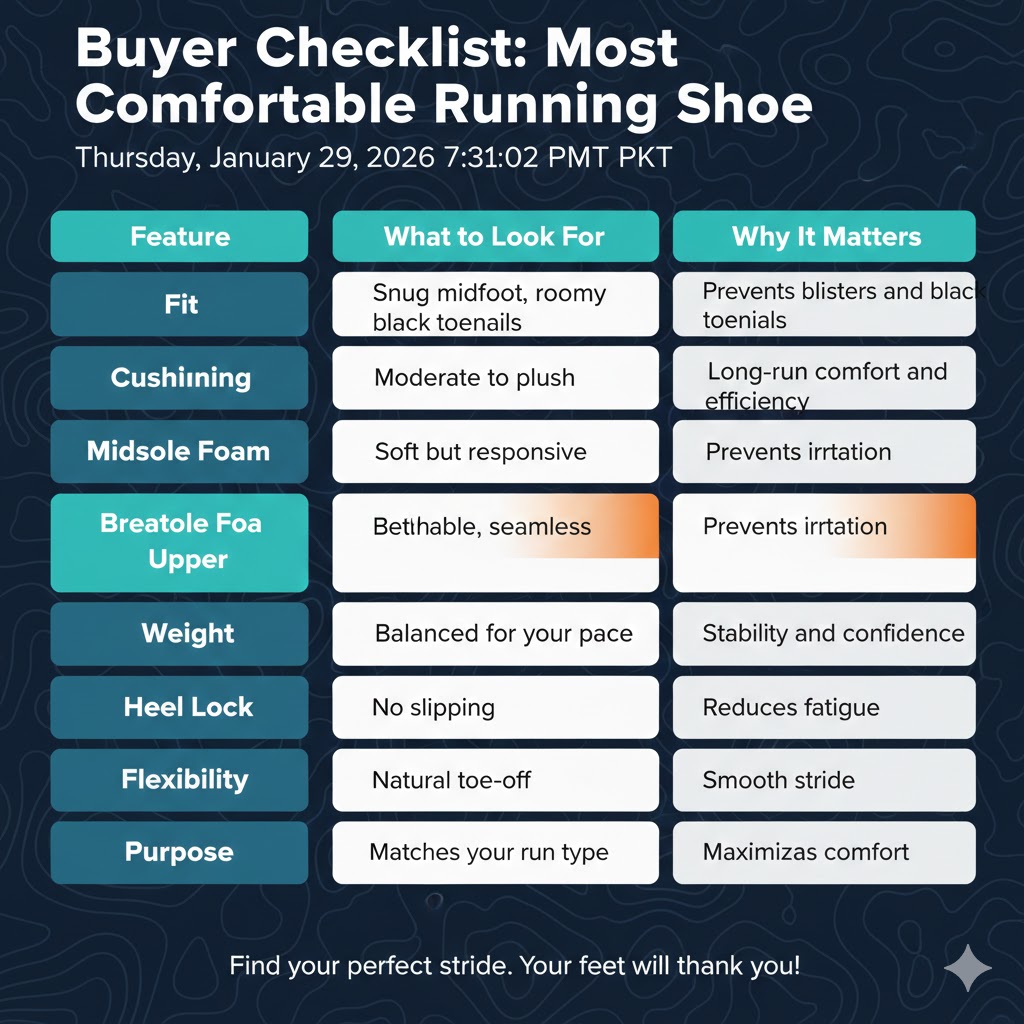
Step 9: Try Before You Commit (If Possible)
The final and most practical step in securing the perfect pair of performance footwear is the “live test.” Never rely solely on a shoe’s appearance or technical specifications; instead, prioritize a brief walk and jog while in the store. A shoe that feels comfortable while standing may reveal irritating pressure points, heel slippage, or restrictive arch support once you are in motion. It is also crucial to test the fit on both feet, as most people have slight discrepancies in foot length or width. Sizing for your larger foot ensures that you won’t suffer from constricted toes or circulation issues during the natural swelling that occurs during a workout.
In the modern marketplace, many runners take advantage of the flexible return policies offered by specialized online running retailers. These policies often allow for a “trial period,” allowing you to test the shoes on a treadmill or a clean indoor surface to ensure the biomechanical fit is truly correct before committing to them for outdoor use. This is particularly helpful for identifying “hidden” discomforts that may only surface after twenty minutes of consistent movement. If you feel any pinching, rubbing, or a “fighting” sensation against your stride during this trial, it is a clear sign that the shoe is not the right match for your foot’s unique geometry.
The golden rule of running shoe selection is to trust your body’s immediate feedback: discomfort rarely disappears with mileage. While some minor softening of the midsole foam may occur, a shoe that is fundamentally uncomfortable out of the box will almost certainly lead to blisters or overuse injuries rather than “breaking in” to fit you. By listening to these early signals and being willing to swap a model that doesn’t feel like a natural extension of your leg, you invest in your long-term running health. Choosing the right shoe is a subjective process, and your personal comfort is the only metric that truly guarantees a successful, pain-free training season.
Common Mistakes to Avoid
Avoiding common footwear pitfalls is essential for maintaining foot health and peak athletic performance. One of the most frequent mistakes is buying shoes that are too small, often because runners stick to their casual shoe size without accounting for the natural foot expansion that occurs during exercise. This error leads to bruised toenails and restricted blood flow. Similarly, many athletes fall into the trap of choosing shoes based solely on online reviews or influencer endorsements. While professional feedback helps understand technical specs, it cannot account for your unique bone structure and gait; what feels like a “dream shoe” for a reviewer might cause significant arch pain for you.
Another critical oversight is ignoring toe box width. Even if a shoe is the correct length, a narrow forefoot can compress the metatarsals, leading to numbness or bunions. It is also a misconception to assume that a higher price tag guarantees comfort. Expensive “super shoes” are often designed for elite racing and contain rigid carbon plates or aggressive geometries that may be far less comfortable for daily training than a standard mid-range trainer. True value in a running shoe is found in how well the structural “last” of the shoe matches your foot shape, not the complexity of its marketing.
Finally, you must be vigilant about the lifespan of your gear, as using worn-out shoes is a primary cause of avoidable injury. Most high-quality midsoles lose their structural integrity and shock absorption capabilities between 500–700 km (300–500 miles). Even if the rubber outsole still “looks fine,” the internal foam often undergoes compression set, leading to a “dead” feel that increases the impact on your joints. Monitoring your mileage and replacing your footwear before the cushioning fully collapses keeps you protected. By avoiding these common errors and trusting your own physical feedback over brand hype, you can ensure every run remains comfortable and productive.
Ultimately, the quest for the most comfortable running shoe is a deeply personal journey rather than a one-size-fits-all solution. The “perfect” pair is defined by its ability to harmonize with your unique foot shape, dampen impact forces, and align seamlessly with your natural gait cycle. When a shoe is truly right for you, it achieves a “disappearing act.” It ceases to be a piece of equipment you’re conscious of and becomes a natural extension of your body. By using technical criteria like midsole density, heel drop, and upper breathability as a filter rather than a rigid rulebook, you empower yourself to find a shoe that invites you to run further and faster.
Always remember that in the world of sports science, subjective comfort is a primary indicator of mechanical efficiency. If a shoe feels intuitive and supportive during movement, your body is likely under less stress, which significantly reduces the risk of overuse injuries. Prioritizing this internal feedback over external marketing trends or aesthetic appeal ensures that your gear remains a catalyst for your success.
Comfort leads to consistency, and consistency leads to progress. When you aren’t distracted by blisters or joint aches, you can focus entirely on your training goals and the joy of the run itself. Treat your footwear as a long-term investment in your health, and never settle for a pair that provides anything less than a smooth, protected ride from start to finish.
Frequently Asked Questions (FAQ)
Q1: What is the most important factor for running shoe comfort? The Fit. No matter how advanced the technology is, a shoe that doesn’t match your foot’s anatomy will cause issues. Focus on having a thumb-width of space in the toe box and a secure, slip-free heel.
Q2: Should running shoes feel comfortable immediately? Yes. While the midsole foam may soften slightly after a few miles, the “break-in period” is largely a myth for modern running shoes. If you feel pinching, numbness, or rubbing in the store, those sensations will only intensify during a run.
Q3: Are cushioned shoes better for beginners? Generally, yes. Beginners often have muscles and joints that are still adapting to the high-impact nature of the sport. Maximal or moderate cushioning helps dampen these impact forces and can reduce the initial soreness associated with starting a running routine.
Q4: How often should I replace my running shoes? Most high-quality trainers should be replaced every 500–700 km (300–500 miles). Even if the outer tread looks new, the internal foam loses its ability to absorb shock over time, which can lead to increased joint pain.
Q5: Can I use the same shoe for walking and running? Occasionally, yes. However, running involves much higher impact forces and a different gait than walking. Dedicated running shoes are engineered specifically for forward propulsion and high-stress landings, making them the safer choice for regular training.
Q6: Is it okay to buy running shoes online? Yes, provided the retailer offers a generous return policy. Since you can’t try them on first, look for stores that allow you to test the shoes (at least indoors) and return them if the arch support or width doesn’t feel right.
Q7: Do I need a wide-width shoe? If you consistently experience “hot spots” on the sides of your feet or if your pinky toe feels squashed, you likely need a wide-width (2E or D) model. Many top brands now offer their most popular shoes in multiple widths to accommodate different foot shapes.
Q8: Does running on a treadmill require different shoes than road running? Not necessarily, but you can often get away with slightly less cushioning on a treadmill because the belt itself has some “give.” For road running, a more durable outsole and higher shock absorption are usually preferred for comfort.