Why Overlanding in the USA Is a Must‑Do Adventure
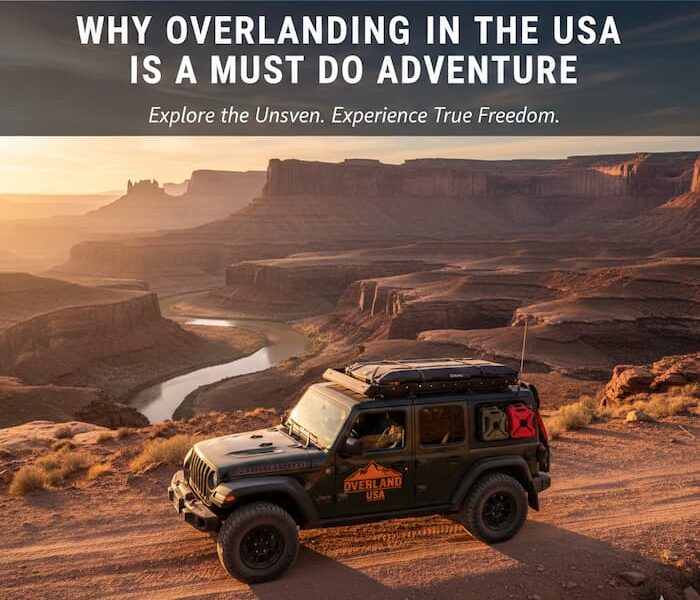
February 15, 2026Overlanding in the USA isn’t just a road trip. It’s a complete immersion into nature, culture, and self-sufficient travel. It’s about leaving the highways behind, slowing down, and discovering the hidden backroads that most travelers never see. Whether you’re driving a 4×4 truck, off-road SUV, adventure van, or fully built overlanding rig, these routes offer diverse terrain, epic scenery, and the freedom to explore remote regions at your own pace. Unlike traditional travel, overlanding focuses on the journey rather than the destination. You’re not rushing to check off landmarks; you’re setting up camp beside alpine lakes, navigating desert trails, cooking under the stars, and waking up miles away from crowds. In 2026 and beyond, overlanding continues to grow across the United States as more travelers seek off-grid experiences, digital detox adventures, and meaningful outdoor exploration
What Makes a Great Overlanding Route?
Overlanding has evolved from a niche hobby into a mainstream adventure movement. Here’s why:
1. The Rise of Self-Sufficient Travel
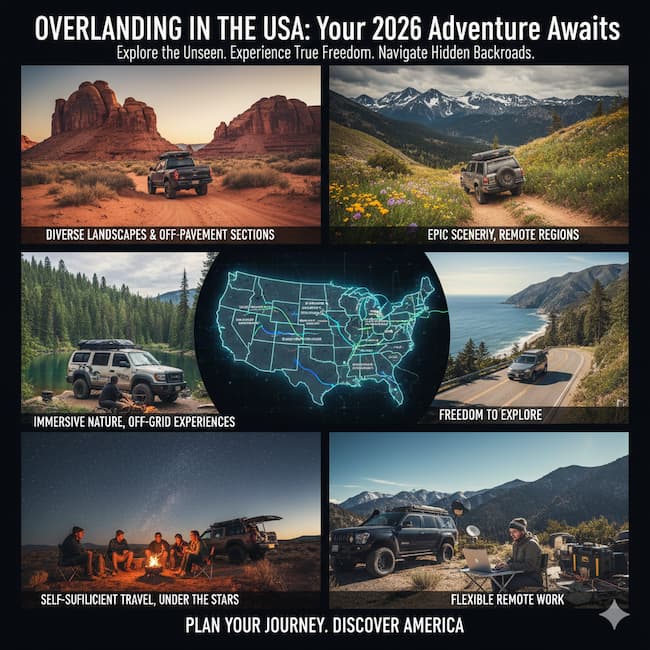
Travelers increasingly prefer independence over structured tours. With rooftop tents, portable power stations, recovery gear, and GPS mapping apps, modern overlanders can confidently explore remote terrain.
2. Flexible Remote Work
The rise of digital nomad lifestyles allows adventurers to work from anywhere. A scenic mountain overlook can double as an office for the day.
3. Desire for Off-Grid Experiences
Crowded tourist hubs are losing appeal. Travelers now seek dispersed camping, solitude, and authentic outdoor immersion.
4. Expanding Vehicle Options
From lifted trucks to converted vans and compact AWD crossovers, overlanding is no longer limited to extreme off-roaders.
Overlanding in the USA: What Makes a Great Overlanding Route?
Not every scenic drive qualifies as a true overlanding route. The best routes combine adventure, beauty, and opportunities for self-reliant travel.
• Diverse Landscapes
A great overlanding route transitions through varied terrain, deserts, forests, mountains, rivers, coastal stretches, and high plains. For example, routes near Moab offer red rock desert landscapes and technical slickrock trails, while areas around Olympic National Park offer lush rainforests and rugged coastlines.
• Off-Pavement Sections
Gravel roads, forest service tracks, BLM land trails, and technical 4×4 segments are essential. These backroads offer both challenge and solitude.
• Camping & Dispersed Sites
Overlanding thrives on freedom. Routes with ample Bureau of Land Management (BLM) land or National Forest access allow dispersed camping away from developed campgrounds.
• Cultural & Historical Richness
The best routes pass through ghost towns, Native American heritage sites, mining history areas, and iconic landmarks. Trails that intersect areas near the Grand Canyon or the Great Smoky Mountains National Park blend nature with heritage.
• Accessibility & Navigation Support
Great routes provide reliable GPS tracks, paper maps, fuel stops within a reasonable distance, and moderate-to-advanced trail options for different skill levels.
In the sections below, we’ll break down some of the top overlanding routes in the USA that every adventure traveler should consider for 2026 and beyond.
1. Trans‑America Trail (TAT)
Overview
The Trans‑America Trail (TAT) is arguably the most iconic overlanding route in the USA. Stretching from the East Coast in Tennessee to the West Coast in Oregon, this loosely defined route traverses backroads across roughly 5,000 miles of dirt, gravel, and forest trails.
Why It’s Legendary
- Crosses 10 states on mostly unpaved roads
- Showcases dramatic shifts in landscape from Appalachian forests to the Southwest deserts
- Perfect for 4×4 vehicles, adventure bikes, and spirits of exploration
Route Highlights
- Cumberland Gap – rich frontier history
- Ozark National Forest – scenic mountain terrain
- Continental Divide – dramatic elevation and views
- Sierra Nevada approach – breathtaking alpine scenery
Best Time to Go
Late spring through early fall (May–September) when high mountain passes are clear.
Tips for Tackling the TAT
- Bring detailed offline maps (Gaia GPS, FarOut)
- Plan fuel stops carefully; some sections are remote
- Pack recovery gear and spare tires
- Respect private land and trail closures
2. The Great Divide Mountain Bike Route (Overland Adaptation)
Overview
Originally designed for mountain bikes, the Great Divide Mountain Bike Route (GDMBR) can be adapted into an incredible overlanding corridor for 4x4s and adventure rigs. Extending from Canada to Mexico, this route follows the Continental Divide through Montana, Wyoming, Colorado, and New Mexico.
Overlanding Appeal
- Rugged high‑altitude terrain
- Epic alpine passes and wildlife sightings
- Remote campsites with star‑filled skies
Must‑See Segments
- Yellowstone vicinity – wildlife and geothermal wonders
- Colorado Rockies – high passes and deep valleys
- San Juan Mountains – historic mining towns and wild scenery
What You’ll Need
- Altitude‑ready vehicle maintenance
- Cold weather gear (even in summer)
- Knowledge of water crossings and mountain weather
3. Utah’s White Rim Road (Canyonlands)
Overview
Located in Canyonlands National Park, White Rim Road is a premier overlanding experience that blends rugged desert terrain with breathtaking canyon vistas. This 100‑mile loop banks along dramatic cliff edges, perfect for seasoned overlanders.
Why It’s a Must
- Continuous 4×4 trail with technical sections
- Immense rock formations and desert isolation
- Proximity to Moab’s adventure culture
Trail Features
- Deep canyons and sandstone cliffs
- Natural bridges and rock arches
- Limited services – requires self‑sufficiency
Best Time
Spring and fall for moderate temperatures; winter for solitude.
White Rim Road Prep
- Reserve permits (required)
- Bring extra water and fuel
- Off‑road tires and skid plates are recommended
4. Alpine Loop (Colorado)
Overview
The Alpine Loop in Colorado connects Silverton, Ouray, and Lake City via high‑elevation backroads. While shorter than other long-range routes, its alpine terrain makes it one of the most scenic overlanding experiences in the USA.
Scenic Highlights
- 12,000+ foot passes
- Wildflower valleys and historic mining sites
- Crystal clear mountain streams
Recommended Vehicles
- High‑clearance 4×4 with good torque
- AWD capable SUVs with off‑road tires
Best Seasons
Late June through September, when the snow melts and passes open.
Tips for Alpine Loop
- Check weather forecasts—storms move fast
- Drive slowly on narrow ridge routes
- Bring warm layers—even in summer
5. Pacific Coast Highway + Backroad Extensions
Overview
While not a traditional off‑road trail, the Pacific Coast Highway becomes an overlanding favorite when combined with beach access roads, forest service trails, and hidden backroads running from Washington through California to Southern Oregon.
Why It’s Special
- Stunning ocean views
- Giant redwood forests
- Coastal campgrounds and dispersed beach sites
Highlights Along the Way
- Olympic Peninsula forests
- Redwood National & State Parks
- Big Sur coastline
- Mendocino’s forest loops
Overlanding Tips
- Many beach access roads require AWD/4WD
- Watch tides and beach conditions
- Use local traffic apps to avoid closures
6. The Mojave Road (California)
Overview
Crossing the California desert from East to West, the Mojave Road is a classic overlanding corridor that has connected travelers for centuries. Today, it remains one of the most iconic desert routes in the USA.
What You’ll Experience
- Arid landscapes and ancient petroglyphs
- Sand washes and rocky terrain
- Historic forts and ghost towns
Best Time to Visit
Fall through spring to avoid extreme summer heat.
Mojave Road Essentials
- Extra water and shade solutions
- Sand recovery gear
- Check for closure info—desert routes can shift
7. East Coast Backroads & Forests
Overview
The East Coast may not be known for the classic overlanding image, but routes through Appalachian backroads, Blue Ridge Parkway adjacent trails, and National Forest forest service roads deliver an overlanding vibe with lush greenery and hidden trails.
Top Spots
- Smoky Mountains Forest Service Roads
- Cherokee National Forest trails
- Blue Ridge backroads
Why It’s Worth Exploring
- Miles of shaded forest routes
- Water crossings and creekside camps
- Rocky Ridge scenic lookouts
East Coast Overlanding Tips
- Night driving can be tricky; bring good lighting
- Check trail permissions; some roads close seasonally
- Campsites are plentiful, but check permit rules
Overlanding Safety & Preparation
Before heading out on any of these best overlanding routes in the USA, solid preparation is key.
Vehicle Readiness
- Full mechanical inspection
- Off‑road capable tires and a spare
- Recovery gear (winch, straps, shovel)
- Suspension and skid protection
Navigation Tools
- Offline maps (Gaia GPS, FarOut)
- Trail notes and route books
- Backup paper maps
- Spot or satellite communicator
Camping & Survival Gear
- Water storage and filtration system
- High‑calorie food and cooking gear
- Weather‑ready bedding
- First aid and emergency kits
Top Overlanding Tips for 2026
Respect Land Access Rules
Always check for land closures, private property boundaries, and forest service regulations. Many routes cross mixed‑use terrains, and respecting access rules keeps trails open for everyone.
Practice Leave No Trace
Pack out all waste, avoid cutting switchbacks, and respect wildlife. Responsible overlanders protect nature so future adventurers can enjoy it too.
Share Your Plans
Let someone know your itinerary and expected return, especially for remote routes where the signal is weak or absent.
Start Your USA Overland Adventure
From the dusty desert expanses of the Mojave Desert and Utah’s legendary White Rim Road to the high-alpine passes of the Colorado Rocky Mountains and the lush, winding forest backroads of the East Coast, the best overlanding routes in the USA deliver unmatched geographic diversity. Within a single multi-state journey, you can transition from red rock canyons and slickrock plateaus to snow-capped summits, dense hardwood forests, river valleys, and coastal stretches. Each region offers its own rhythm—desert silence under vast star fields, crisp mountain mornings above tree line, and humid woodland trails rich with history and wildlife. This variety is what makes overlanding in America so compelling: no two routes feel the same, and every mile introduces a new terrain challenge or scenic reward.
With thoughtful preparation, an off-road-ready vehicle, reliable navigation tools, and a spirit of curiosity, your next overland trip can become more than just an adventure; it can become a defining experience. Planning fuel stops, understanding seasonal weather patterns, packing recovery gear, and respecting Leave No Trace principles all play a role in turning a good trip into a great one. Overlanding rewards those who move deliberately, adapt to changing conditions, and embrace the unexpected. Whether you’re tackling remote desert tracks or weaving through forest service roads, the journey itself becomes the destination, filled with campfire nights, panoramic vistas, and the freedom that only the open backcountry can provide.
Start planning your 2026 overlanding adventure today and explore America in a way few get to experience: through remote trails, hidden landscapes, and the raw beauty that lies between the roads less traveled.
Frequently Asked Questions
What is overlanding, and how is it different from camping?
Overlanding is a self-reliant, vehicle-based adventure focused on exploration and long-distance travel, often on remote backcountry routes. Unlike traditional camping, which usually involves staying at one campground, overlanding emphasizes the journey itself — navigating trails, discovering remote landscapes, and camping in dispersed or off-grid locations.
Why is overlanding so popular in the USA?
Overlanding is booming in the United States because of:
Vast public lands
Diverse terrain (deserts, forests, mountains)
Extensive off-road trail networks
Growing outdoor lifestyle movement
States like Utah, Colorado, and Arizona offer some of the best overlanding routes thanks to scenic backcountry roads and accessible public land.
What are the best states for overlanding in the USA?
Some of the top overlanding destinations include:
Utah – Iconic desert trails and red rock landscapes
Colorado – High alpine passes and mountain routes
Arizona – Remote desert backroads
California – Coastal trails and desert terrain
Montana – Vast wilderness and forest service roads
Each state offers unique terrain and adventure styles.
Do you need a 4×4 vehicle for overlanding?
Not always. Many beginner-friendly routes can be completed with AWD crossovers or high-clearance SUVs. However, a 4×4 vehicle is highly recommended for:
Rocky terrain
Deep sand
Muddy trails
Remote mountain routes
Serious overlanding routes often require proper off-road capability and recovery gear.
Is overlanding safe for beginners?
Yes, if done properly. Beginners should:
Start with well-documented routes
Travel with a partner or group
Carry recovery gear
Inform someone of their travel plans
Monitor weather conditions
Preparation is key to a safe and enjoyable overlanding experience.
How much does it cost to start overlanding?
Costs vary widely depending on your setup. Basic overlanding can start with:
A reliable SUV or truck
Basic camping gear
Portable fridge or cooler
Navigation tools
Advanced setups with rooftop tents, suspension upgrades, and recovery systems can increase costs significantly. You can start simple and upgrade over time.
What gear is essential for overlanding?
Essential overlanding gear includes:
Recovery kit (tow straps, traction boards)
Air compressor
Spare tire
Navigation system (offline maps)
Camping setup (tent or rooftop tent)
Portable power source
First aid kit
Proper preparation separates safe overlanders from risky adventurers.
Is overlanding legal everywhere in the USA?
Overlanding is legal on designated public lands and approved backcountry routes. Many areas are managed by the Bureau of Land Management (BLM) and the United States Forest Service.
Always:
Follow local regulations
Respect trail restrictions
Practice Leave No Trace principles
Illegal off-road driving can result in fines and environmental damage.
What is the difference between overlanding and off-roading?
Off-roading focuses primarily on technical driving challenges and obstacles. Overlanding focuses on:
Long-distance travel
Self-sufficiency
Exploration
Camping along the journey
Off-roading can be part of overlanding, but overlanding is about the entire experience.
Is overlanding worth it?
Absolutely. Overlanding offers:
Freedom to explore remote areas
Deeper connection with nature
Self-reliant adventure
Unique travel experiences
For outdoor enthusiasts, it’s one of the most rewarding ways to experience the American landscape.
What is overlanding, and how is it different from camping?
Overlanding is a self-reliant, vehicle-based adventure focused on exploration and long-distance travel, often on remote backcountry routes. Unlike traditional camping, which usually involves staying at one campground, overlanding emphasizes the journey itself — navigating trails, discovering remote landscapes, and camping in dispersed or off-grid locations.
Why is overlanding so popular in the USA?
Overlanding is booming in the United States because of:
Vast public lands
Diverse terrain (deserts, forests, mountains)
Extensive off-road trail networks
Growing outdoor lifestyle movement
States like Utah, Colorado, and Arizona offer some of the best overlanding routes thanks to scenic backcountry roads and accessible public land.
What are the best states for overlanding in the USA?
Some of the top overlanding destinations include:
Utah – Iconic desert trails and red rock landscapes
Colorado – High alpine passes and mountain routes
Arizona – Remote desert backroads
California – Coastal trails and desert terrain
Montana – Vast wilderness and forest service roads
Each state offers unique terrain and adventure styles.
Do you need a 4×4 vehicle for overlanding?
Not always. Many beginner-friendly routes can be completed with AWD crossovers or high-clearance SUVs. However, a 4×4 vehicle is highly recommended for:
Rocky terrain
Deep sand
Muddy trails
Remote mountain routes
Serious overlanding routes often require proper off-road capability and recovery gear.
Is overlanding safe for beginners?
Yes, if done properly. Beginners should:
Start with well-documented routes
Travel with a partner or group
Carry recovery gear
Inform someone of their travel plans
Monitor weather conditions
Preparation is key to a safe and enjoyable overlanding experience.
How much does it cost to start overlanding?
Costs vary widely depending on your setup. Basic overlanding can start with:
A reliable SUV or truck
Basic camping gear
Portable fridge or cooler
Navigation tools
Advanced setups with rooftop tents, suspension upgrades, and recovery systems can increase costs significantly. You can start simple and upgrade over time.
What gear is essential for overlanding?
Essential overlanding gear includes:
Recovery kit (tow straps, traction boards)
Air compressor
Spare tire
Navigation system (offline maps)
Camping setup (tent or rooftop tent)
Portable power source
First aid kit
Proper preparation separates safe overlanders from risky adventurers.
Is overlanding legal everywhere in the USA?
Overlanding is legal on designated public lands and approved backcountry routes. Many areas are managed by the Bureau of Land Management (BLM) and the United States Forest Service.
Always:
Follow local regulations
Respect trail restrictions
Practice Leave No Trace principles
Illegal off-road driving can result in fines and environmental damage.
What is the difference between overlanding and off-roading?
Off-roading focuses primarily on technical driving challenges and obstacles. Overlanding focuses on:
Long-distance travel
Self-sufficiency
Exploration
Camping along the journey
Off-roading can be part of overlanding, but overlanding is about the entire experience.
Is overlanding worth it?
Absolutely. Overlanding offers:
Freedom to explore remote areas
Deeper connection with nature
Self-reliant adventure
Unique travel experiences
For outdoor enthusiasts, it’s one of the most rewarding ways to experience the American landscape.