
Your First Swimming Lesson: A Complete Beginner’s Guide to Start Confidently
December 26, 2025Starting swimming for the first time can feel exciting and a little intimidating. Many beginners worry about breathing, floating, or even stepping into deep water. The good news? Everyone starts exactly where you are now.
This complete beginner swimming guide will walk you through everything you need to know before your first swimming lesson, from preparation and safety rules to basic techniques and confidence-building tips. Whether you’re learning for fitness, fun, or safety, this guide will help you start strong and swim smart.
Before jumping in, make sure you have the right equipment. If you haven’t already, check out our detailed guide on Essential Swimming Gear for Beginners on RatedTerrain. It covers must-have items like goggles, swimwear, and caps that make learning easier and more comfortable.
Beginner Swimming Guide: What to Expect in Your First Swimming Lesson
What to Expect in Your First Swimming Lesson
Your first swimming lesson is not about speed or perfection. It’s about comfort, safety, and confidence.
Here’s what usually happens:
- Introduction to the pool environment
- Basic water entry and exit techniques
- Learning how to relax in water
- Simple floating and breathing exercises
Most beginner swimming lessons take place in shallow water, so you can stand comfortably while learning.
Preparing for Your First Swimming Lesson
1. Choose the Right Pool
Finding the right “terrain” is the first step toward a successful swim. For a beginner, the environment acts as your silent partner in learning; therefore, you should prioritize a facility that is clean, well-maintained, and professionally staffed. Ideally, look for a pool with a significant shallow section where you can comfortably stand with your head well above water; this “safety net” is crucial for building confidence during your first few submersions. Clear water visibility is equally important, as it allows you to see the bottom and lane markings, reducing the sensory disorientation that often occurs when underwater. Finally, always ensure there is lifeguard supervision on deck. Knowing a professional is watching over the area allows your mind to relax, shifting your focus from “survival” to “skill-building.” While indoor pools provide a consistent, climate-controlled environment for year-round progress, outdoor pools can offer a refreshing and scenic experience during the warmer months. Just be sure to choose whichever makes you feel most at ease.
2. Wear Comfortable Swimming Gear
The right equipment acts as your support system, allowing you to focus entirely on your technique rather than managing discomfort or distractions. For beginners, the goal is “function first.” Start with well-fitted swimwear made from chlorine-resistant fabric; it should feel secure enough to stay in place during kicks and glides without being restrictive. Anti-fog swimming goggles are perhaps your most vital tool, as they provide a clear view of your underwater “terrain” and protect your eyes from irritation, which significantly reduces the urge to panic. While a swim cap is often considered optional, it is incredibly helpful for keeping hair out of your face and maintaining a streamlined head position. Finally, don’t forget the “dry-side” essentials: a high-absorbent towel for post-swim warmth and a pair of flip-flops for hygiene and safety while walking on slippery pool decks. When your gear fits correctly, you stop worrying about your equipment and start focusing on your progress.
3. Eat Light & Stay Hydrated
Fueling your body correctly is essential for maintaining focus and energy during your first session. Because swimming involves horizontal movement and constant core engagement, you should avoid heavy or greasy meals immediately before jumping in. Instead, aim to eat a light, easily digestible snack, such as a banana, a piece of toast, or a small yogurt, about 1–2 hours before your lesson. This provides a steady stream of energy without making you feel sluggish or nauseous in the water. Equally important is your hydration. It is a common myth that you don’t sweat while swimming; in reality, the water masks your perspiration, and you can become dehydrated quite quickly. Drinking water before and after your session ensures your muscles stay supple and helps prevent the “swimmer’s fatigue” that often hits once you leave the pool. Think of it as preparing your internal engine for the physical “terrain” ahead.
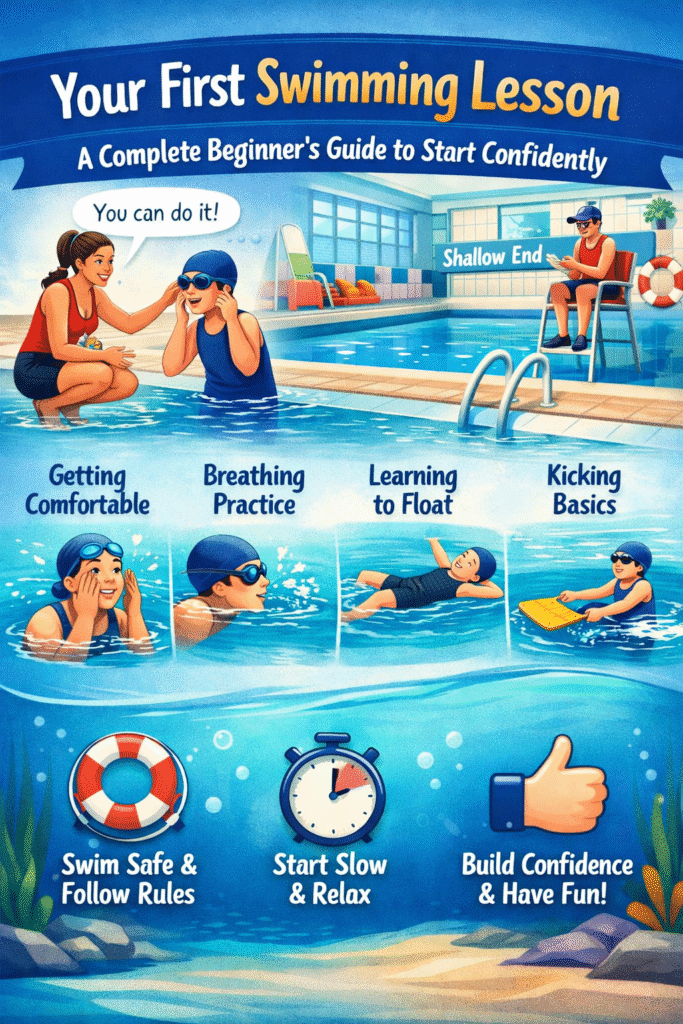
Swimming Safety Rules Every Beginner Must Know
Safety comes first, especially for beginners.
Essential Swimming Safety Tips:
- Never swim alone
- Follow pool rules at all times
- Stay in shallow water until confident
- Avoid running near the pool
- Inform the instructor if you feel tired or dizzy
Learning these rules early builds strong swimming habits and reduces fear.
Basic Swimming Skills You’ll Learn First
It is a common misconception that you will begin your first lesson by immediately learning “how to swim laps.” In reality, a professional introduction to the water focuses entirely on foundational skills, rather than specific strokes like freestyle or breaststroke. Think of this as the “blueprint” phase of your journey. Before you can move efficiently through the water, you must first master the art of buoyancy, breath control, and body position. Trying to learn a complex stroke while you are still tensing your muscles or holding your breath is like trying to run before you can stand. By stripping away the complication of arm movements and focusing on how your body interacts with the water’s density, you build a “muscle memory” of safety. These early drills may seem simple, but they are the essential building blocks that turn a nervous beginner into a relaxed, efficient swimmer.
1. Getting Comfortable in the Water
Before you ever attempt a stroke, your first priority is simply becoming “water-aware.” For many, the most significant barrier to swimming isn’t a lack of physical ability, but rather a natural “sensory overload” caused by a new environment. To combat this, your initial steps involve low-stakes immersion to desensitize your nervous system and build a sense of safety.
- Walking in the Water: You will start by walking through the shallow end, feeling the weight and resistance of the water against your legs. This helps you ground your sense of balance and understand how the water moves around you.
- Sitting on the Pool Steps: This is a vital exercise that allows you to feel the water rising up to your chest while your feet remain firmly planted. It gives you a sense of control over your depth and buoyancy.
- Splashing Water on the Face: This simple act helps bridge the gap between being “on” the water and being “in” it. It prepares your reflexes for submersion and reduces the “startle” response when your face eventually goes under.
These foundational movements might seem basic, but they are designed to quiet the mind’s natural “fight or flight” response. By the time you are ready to submerge, you will no longer view the water as a foreign obstacle, but as a familiar “terrain” where you feel safe and in command.
2. Breathing Techniques for Beginners
Mastering your breath is arguably the most critical milestone in your swimming journey. Most of the “panic” that beginners feel in the water isn’t actually a fear of the water itself, but rather a fear of not being able to breathe. To swim with grace and endurance, you have to retrain your body to follow a specific, rhythmic cycle that is the opposite of how we breathe on land.
- The “Mouth In, Nose Out” Rule: In swimming, timing is everything. You will practice inhaling quickly and deeply through your mouth while your head is above the surface. Once submerged, you switch to exhaling slowly and steadily through your nose (or mouth). This constant outward flow of air creates a “pressure shield” that prevents water from entering your nasal passages.
- The Art of Blowing Bubbles: This is your first real step into underwater control. By holding onto the pool wall and submerging just your mouth and nose, you learn to blow a steady stream of bubbles. This isn’t just for fun, it teaches you to stay relaxed and maintain a clear airway while submerged.
- Rhythmic Breathing: The goal of these drills is to eliminate the “gasping” sensation. By practicing a rhythmic cycle dip, exhale, surface, inhale you teach your nervous system that oxygen is always available.
Once you master this “rhythmic exchange,” swimming stops being a struggle for air and starts becoming a calm and controlled experience. When you aren’t fighting for your next breath, your body naturally relaxes, making it much easier to learn the movements of the arms and legs.
3. Floating Basics: The Foundation of Trust
Floating is the definitive “aha!” moment for every new swimmer. It is the point where you stop fighting the water and start trusting its natural physics to hold you up. Developing this skill is less about physical strength and more about body balance and mental surrender. When you learn to float, you gain a vital safety tool; it is your “rest button” in the water, ensuring that even if you get tired, you can always stay safe and buoyant.
- The Back Float (The Starfish): This is the ultimate survival skill. By tilting your head back, pushing your chest toward the sky, and spreading your arms and legs wide like a starfish, you learn to breathe freely while resting on the surface. The key here is relaxation, the more you relax your muscles, the higher you float. This position teaches you that the water is a supportive cushion, not a void.
- The Front Float (with Support): Often practiced with the help of the pool wall or a kickboard, the front float involves putting your face in the water and letting your legs rise behind you. This drill is essential for understanding horizontal body position. It teaches you how to keep your hips high, which is the secret to moving efficiently through the water without “dragging” your lower half.
- Reducing the Panic Response: Floating is the ultimate cure for water anxiety. Once you realize that your body is naturally buoyant, the fear of “sinking” evaporates. This newfound trust allows you to remain calm in deeper water and provides the perfect platform for adding arm and leg movements later on.
Pro-Tip: If you find your legs sinking during a back float, try looking further back toward the wall behind you. Where the head goes, the hips will follow!
4. Kicking Fundamentals: Building Your Engine
Once you have mastered the art of staying level in the water, it is time to introduce propulsion. Kicking is the “engine” of your swim stroke; it provides the drive needed to move forward and helps keep your lower body from sinking. For beginners, the focus isn’t on power or speed, but on developing a smooth, rhythmic motion that originates from the correct part of the body.
- The Flutter Kick: This is the most common kick used in swimming. The most frequent mistake beginners make is “bicycling” their legs by bending too much at the knees. Instead, your instructor will teach you to keep your legs relatively straight, with the movement starting at your hips. Think of your legs as long, flexible whips, your knees should have a slight, relaxed bend, and your toes should be pointed and “floppy” like a ballet dancer’s.
- Using the Pool Edge or Kickboard: To help you isolate your leg muscles, you will likely start by holding onto the pool edge or using a kickboard. This provides a stable platform for your upper body, allowing you to focus entirely on what your legs are doing. By keeping your arms extended on a board, you can practice keeping your head down and your hips high while your legs do the work.
- Strength and Coordination: These drills are essential for building “swimming endurance.” Beyond just moving you forward, a consistent flutter kick improves your overall coordination. It stabilizes your body in the water, preventing you from rolling side-to-side, and ensures that when you eventually add arm strokes, your “engine” is already running smoothly.
The Best Swimming Strokes to Start With
Once you have mastered the basics of floating and kicking, you are ready to introduce the “gears” of swimming: the strokes. While there are four competitive strokes, most beginner programs focus on the one that provides the most efficient transition from land to water.
Why Freestyle (Front Crawl) is the Gold Standard
For the vast majority of new swimmers, Freestyle, also known as the Front Crawl is the most natural starting point. It is the “utility” stroke of the swimming world, perfect for building cardiovascular fitness and moving through the water with minimal resistance.
- Simple, Alternating Movements: The arm action is a straightforward “reach and pull” motion that mimics a natural reaching gesture. This alternating rhythm is easy for the brain to coordinate with a constant flutter kick.
- A Foundation for Breathing: Freestyle teaches the essential skill of side-breathing. Mastering the ability to turn your head to the side to inhale while keeping your body streamlined is a milestone that unlocks long-distance swimming.
- Efficiency: Because it is the fastest stroke, you get the most “distance for your effort,” which is incredibly rewarding for a beginner looking to see immediate progress.
Other Beginner-Friendly Alternatives
While Freestyle is the most common starting point, your instructor might introduce other strokes to help build specific types of confidence:
- Backstroke (The Confidence Builder): Many beginners love the backstroke because your face stays out of the water the entire time. If you struggle with breath control or “water-on-the-face” anxiety, the backstroke allows you to focus on your arm and leg coordination without the added pressure of underwater breathing.
- Breaststroke (The Relaxed Pace): Often called the “leisure stroke,” breaststroke is slower and more stable. It allows you to keep your head above water if necessary and provides a wide, supportive base with the “frog kick.” It’s an excellent choice for those who want a more relaxed, observational pace.
Rated Terrain Tip: Don’t worry about Butterfly or technical racing turns just yet. Advanced strokes require a level of core strength and timing that only comes after your foundational basics are rock solid. Focus on the stroke that makes you feel the most “at home” in your lane.
Common Beginner Swimming Mistakes (And How to Avoid Them)
Swimming is as much about unlearning bad habits as it is about learning new ones. When you first enter the pool, your body’s natural survival instincts often take over, leading to common errors that can make swimming feel much harder than it actually is. By identifying these “efficiency killers” early, you can fast-track your progress and stay relaxed in the water.
- Mistake: Holding Your Breath
- The Fix: Many beginners hold their breath while their face is submerged, which causes carbon dioxide to build up in the lungs. This leads to that “burning” chest sensation and immediate panic. To stay calm, you must always exhale slowly and steadily through your nose or mouth the moment your face hits the water. This keeps your heart rate down and makes room for a fresh breath the second you surface.
- Mistake: Looking Straight Ahead
- The Fix: Instinct tells you to look toward the end of the pool to see where you are going, but lifting your head actually causes your hips and legs to sink like an anchor. To maintain a perfect horizontal balance, keep your head in a neutral position, looking directly at the bottom of the pool. Think of your spine as a straight line from your head to your heels; when your head stays down, your hips stay up.
- Mistake: Tensing the Body
- The Fix: When you’re nervous, your muscles naturally tighten, which makes you less buoyant and more prone to fatigue. In swimming, “stiff” is the enemy of “streamlined.” Focus on relaxing your shoulders, neck, and arms. The water is a dense medium that will support you if you let it; the more relaxed your muscles are, the more naturally you will float.
- Mistake: Skipping the Warm-Up
- The Fix: Jumping straight into cold water with “cold” muscles is a recipe for cramps and poor performance. Before entering the pool, spend five minutes doing light stretches or arm circles to get your blood flowing. Once in the water, start with a few minutes of walking or gentle movement to acclimate your heart rate. A proper warm-up prepares your joints for the full range of motion required for swimming strokes.
Rated Terrain Insight: Avoiding these common pitfalls isn’t just about looking like a pro; it’s about conserving energy. When you fix your head position and breathing, you’ll find you can swim twice as far with half the effort!
Beginner Swimming Workout: Your First Lesson Routine
A structured plan is the best way to transform nervous energy into measurable progress. For your first session, you don’t need to count laps; instead, you should focus on “time in the water.” This 30-minute beginner routine is designed to build your confidence and muscle memory without causing overexertion.
1. The Warm-Up (5 Minutes): Preparing Your Body
Your workout begins with transition. Moving from land to water requires your heart rate and muscles to adjust to a new temperature and resistance level.
- Walking in Shallow Water: Start by simply walking from one side of the shallow end to the other. Feel how the water resists your movement and helps you find your balance.
- Arm Swings & Gentle Stretches: While standing in the water, perform slow arm circles and side stretches. The water provides a gentle massage for your joints, preparing them for a full range of motion.
2. Skill Practice (15 Minutes): The Core Training
This is the “work” phase of your session, where you focus on the foundational skills that make swimming possible.
- Breathing Exercises: Spend 5 minutes at the wall practicing your “bubbles.” Focus on rhythmic breathing, inhaling through the mouth above water and exhaling steadily through the nose underwater.
- Floating Practice: Dedicate time to both front and back floats. Experiment with how your body reacts to the water’s buoyancy when you take a deep breath versus when you exhale.
- Kicking with a Kickboard: Finish this section by grabbing a kickboard. Keep your arms extended and practice a steady flutter kick for short distances. This strengthens your “engine” and helps you practice keeping your hips high.
3. The Cool-Down (10 Minutes): Relaxation and Recovery
Never rush out of the pool immediately after working out. The cool-down is essential for lowering your heart rate and “saving” the progress you just made.
- Easy Back Floating: Spend a few minutes simply resting on your back. Let the water support you completely. This reinforces the idea that the water is a safe, relaxing environment.
- Slow Walking in Water: End your session exactly how you started. Walk slowly through the shallow end, focusing on deep, relaxed breaths. This helps prevent muscle stiffness and allows you to leave the pool feeling refreshed rather than exhausted.
Rated Terrain Tip: This routine is about quality over quantity. If you spend the entire 30 minutes just getting comfortable with breathing and floating, that is a huge success. The laps will come later; for now, focus on how the water feels.
How Often Should Beginners Swim?
One of the most common questions new swimmers ask is how frequently they need to hit the water to see real improvement. Unlike land-based exercises, swimming is a highly technical skill that relies heavily on “water feel” and muscle memory. To see steady progress without feeling overwhelmed, you need to find the “sweet spot” between frequency and recovery.
- The Golden Ratio: 2–3 Sessions Per Week For most beginners, visiting the pool two to three times a week is the ideal frequency. This schedule is frequent enough to keep your body acclimated to the water and ensure your brain “saves” the new motor skills you are learning. If you go only once a week, you may find yourself spending half the lesson just getting comfortable again; going three times allows you to pick up exactly where you left off.
- The Duration: 30–45 Minutes Per Session At this stage, your sessions don’t need to be marathons. 30 to 45 minutes is plenty of time to practice your drills without reaching a point of total physical exhaustion. Because swimming uses muscles you rarely use on land, your body will tire faster than you expect. Keeping sessions concise ensures that your form remains sharp and your movements stay intentional.
- Consistency Over Intensity In the world of swimming, consistency matters far more than intensity. You will gain much more from three relaxed, 30-minute sessions focused on breathing and floating than you will from one high-intensity hour of struggling through laps. Progress in the water isn’t about how hard you push your heart rate; it’s about how much time you spend being “mindful” in the water.
Rated Terrain Wisdom: Think of your swim journey as a marathon, not a sprint. If you stay consistent, you’ll notice that movements which felt impossible in Week 1, like a 10-second float or a coordinated kick, become second nature by Week 4. Trust the timeline and enjoy the process!
Overcoming Fear of Water as a Beginner
It is a common misconception that fear of water is something only children experience. In reality, many adults face a natural hesitation or even a deep-seated anxiety when stepping into a pool for the first time. On Rated Terrain, we believe that acknowledging this fear is the first step toward conquering it. Fear is a survival instinct, but with the right approach, you can transform that “fear of the unknown” into a “respect for the element.”
- Learn at Your Own Pace: The biggest mistake a nervous beginner can make is comparing their progress to someone else’s. Swimming is a deeply personal journey. If you need to spend your entire first lesson just standing in the shallow end or sitting on the steps, do it. There is no “stopwatch” on your comfort; you move forward only when your body and mind feel ready.
- Practice in Shallow Water: Confidence is built on a foundation of safety. By staying in the shallow end where you can firmly plant your feet and keep your head above water at any time, you eliminate the fear of “sinking.” Knowing that you are always in control of your vertical position allows your nervous system to relax and focus on the skills at hand.
- Focus on Breathing: Panic and breathing are closely linked. When we are scared, we tend to hold our breath or take shallow gasps, which tells the brain there is an emergency. By focusing on slow, rhythmic “bubbles” (exhaling underwater), you manually override your stress response. Controlled breathing is the ultimate “anchor” for a calm mind.
- Trust Your Instructor: A professional instructor is trained not just in stroke technique, but in water psychology. They act as your safety net, ensuring you are never pushed into the “red zone” of panic. Open communication is key, tell them your specific fears so they can tailor the lesson to build your trust gradually.
- Celebrate Small Wins: In the beginning, progress isn’t measured in laps; it’s measured in moments. Putting your ears in the water, blowing five bubbles in a row, or lifting your feet off the floor for a two-second float are all massive victories.
- Rated Terrain Mindset: Confidence doesn’t happen all at once; it grows with each session. Every time you show up at the pool, you are proving to yourself that you are stronger than your fear. Before long, the water will stop feeling like a threat and start feeling like your playground.
The Lifelong Benefits of Learning to Swim
While many people pick up swimming for a specific vacation or event, the true value of the sport lies in its long-term impact on your quality of life. Whether you are starting at age five or fifty-five, swimming is a unique “all-in-one” activity that supports your physical, mental, and safety needs simultaneously. On Rated Terrain, we view swimming as the ultimate lifestyle investment.
- A True Full-Body Workout: Unlike many gym exercises that isolate specific muscles, swimming requires every major muscle group to work in harmony. To move through the water, you engage your core for stability, your arms for pull, and your legs for drive. This leads to balanced muscle toning and functional strength that translates into better posture and movement on land.
- Zero Impact on Joints: One of the most significant advantages of swimming is its low-impact nature. Because water supports up to 90% of your body weight, it eliminates the “pounding” stress on your knees, hips, and ankles found in running or weightlifting. This makes it the ideal activity for people of all ages, including those recovering from injuries or managing joint sensitivity.
- Cardiovascular & Heart Health: Swimming is a powerful aerobic exercise. The requirement for rhythmic, controlled breathing strengthens the heart and improves lung capacity. Regular sessions can lead to lower blood pressure, improved circulation, and better overall heart health, making it a primary tool for longevity.
- Building Unshakeable Confidence: There is a unique psychological boost that comes from mastering an environment as intimidating as the water. As you transition from a nervous beginner to a capable swimmer, that sense of accomplishment overflows into other areas of your life. It builds mental resilience and proves that you can conquer new challenges regardless of your starting point.
- An Essential Life Safety Skill: Beyond fitness, swimming is a non-negotiable survival skill. Water is everywhere—from backyard pools to the open ocean. Learning to swim provides you with the “water literacy” needed to handle emergencies, potentially saving your life or the life of someone else. It is a gift of safety that you carry with you forever.
The Rated Terrain Takeaway: Swimming isn’t just a sport; it’s a lifelong insurance policy for your health. It is one of the few activities you can enjoy from your earliest years well into your senior life, keeping you fit, safe, and confident every step of the way.
Start Slow, Stay Consistent
Your first swimming lesson is more than just a checklist of skills; it is the beginning of a transformative and rewarding journey. It is important to remember that every expert swimmer you see glided through their own “Day One” just like you. The key to long-term success is to honor your own pace. Progress in the water is rarely a straight line; some days you will feel like a natural, and other days you might struggle with a basic float. Both are essential parts of the learning process. By refusing to rush your progress or compare your “Chapter One” to someone else’s “Chapter Ten,” you protect the joy of learning and keep your motivation high.
To make the most of this journey, focus on the three pillars of a successful beginner: proper preparation, safety, and consistency. * Proper Preparation: Being equipped with the right gear, like well-fitted goggles and comfortable swimwear, removes the small distractions that can break your focus.
- Safety First: By respecting pool rules and staying within your depth, you create a “safe zone” where your mind is free to learn rather than worry.
- The Power of Consistency: Real mastery comes from showing up. Each session builds a layer of “water feel” that can’t be taught in a book.
As you continue to practice, you will notice a magical shift: movements that once required intense concentration will start to happen automatically. The water will stop feeling like a heavy resistance and start feeling like a supportive partner. With time and patience, swimming will transition from a challenging workout into a natural, meditative, and deeply relaxing part of your life. Trust the process, enjoy the water, and remember every splash is progress.
[…] you progress beyond the basics, incorporating Must have Swimming gear for beginners, like kickboards and pull buoys, can dramatically accelerate your learning curve […]